Thursday, February 13, 2020

Vitamin D Proven More Effective Than Both Anti-Viral Drugs and Vaccines At Preventing The Flu


The risk of children suffering from flu can be reduced by 50% if they take vitamin D, doctors in Japan have found. The finding has implications for flu epidemics since vitamin D, which is naturally produced by the human body when exposed to direct sunlight, has no significant side effects, costs little and can be several times more effective than anti-viral drugs or vaccines according to research in the American Journal of Clinical Nutrition.
Only one in ten children, aged six to 15 years, taking the sunshine vitamin in a clinical trial came down with flu compared with one in five given a dummy tablet. Mitsuyoshi Urashima, the Japanese doctor who led the trial, told The Times that vitamin D was more effective than vaccines in preventing flu.
Vitamin D was found to be even more effective when the comparison left out children who were already given extra vitamin D by their parents, outside the trial. Taking the sunshine vitamin was then shown to reduce the risk of flu to a third of what it would otherwise be.
Dr. Damien Downing, a doctor and medical consultant has publicly stated that governments “do like” epidemics as a chance to impose their will. The London based doctor has been advising patients to increase their vitamin D intake rather than get the vaccine.
You might be shocked to know that there are many physicians in both Canada and the United States who prescribe as much as 50,000 IU of vitamin D daily as a treatment for a long list of chronic diseases.
Dr. John Cannell, MD, suggests high-dose vitamin D (50,000 IU) be consumed for three days at the first sign of a cold or the flu. If you have an infection, the truth is you need more vitamin D. That’s a given. In other words, vitamin D acts as a natural antibiotic. It works against every type of microbe (viruses, bacteria, fungi and parasites).
Vitamin D deficiency is common during the winter months, especially in countries far north of the equator. Vitamin D acts as an immune system modulator, preventing excessive production of inflammatory cytokines and increasing macrophage (a type of white cell) activity. Vitamin D also stimulates the production of potent anti-microbial peptides in other white blood cells and in epithelial cells lining the respiratory tract, protecting the lungs from infection.
50 Percent Reduction In Flu Infections Using Vitamin D
Altogether 354 children took part in the trial. Vitamin D was found to protect against influenza A but not against the less common influenza B.
The trial, which was double blind, randomised, and fully controlled scientifically, was conducted by doctors and scientists from Jikei University School of Medicine in Tokyo, Japan.
The children were given a daily dose of 1200 IUs (international units) of vitamin D over a period of three months. In the first month children in the group taking the vitamin became ill just as often as those taking the dummy tablet. But by the second month, when the vitamin level in the children’s blood was higher, the advantage of the vitamin was clear.
The Japanese scientists, writing in the American Journal of Clinical Nutrition, say that the anti-viral drugs zanamivir and oseltamivir reduce risk of flu infection by 8 percent in children who have been exposed to infection, compared with a 50 percent or greater reduction with vitamin D.
Anti-virals are typically more effective than vaccines for the influenza virus which suggests that both forms of medical intervention would consistently fail in similar studies when pitted against vitamin D.
Anti-virals are also too expensive, and possibly too toxic, to be given to the population as a whole whereas vitamin D has additional benefits. The sunshine vitamin not only prevents bone fractures but is also believed to reduce risks of cancer, heart disease, diabetes and other illness, including various bacterial as well as viral infections.
The Japanese finding supports a theory that low blood levels of the sunshine vitamin occurring in winter explain why flu epidemics generally peak between December and March.
Vitamin D activates the innate immune system, enabling the body to produce several proteins such as defensin and cathelicidin which trigger cell activity and disable viruses.
Dr John Oxford, professor of virology at Queen Mary School of Medicine, London, said: “This is a timely study. It will be noticed by scientists. It fits in with the seasonal pattern of flu. There is an increasing background of solid science that makes the vitamin D story credible. ”
Dose and Vitamin D Levels Are Critical 
Researchers have recently pinpointed the mechanism behind vitamin D3’s ability to enhance the immune system and why it is so critical to our health.
– Vitamin D is not a vitamin, but a steroid hormone precursor, which has profound effects on innate immunity.
– The amount of vitamin D in most food and nearly all multivitamins is literally inconsequential.
– The correct daily dose of vitamin D for adults is approximately 5,000 IU/day, not the 200 to 600 IU recommended by the Institute of Medicine, the National Institutes of Medicine and the FDA.
– The only blood test to determine vitamin D adequacy is a 25-hydroxy-vitamin D, not the 1,25-di-hydroxy-vitamin D test many physicians now order.
– Healthy vitamin D blood levels are between 70 and 90 ng/ml, levels obtained by fewer than 5% of Americans.
– The mechanism of action of vitamin D in infection, dramatically increasing the body’s production of broad-spectrum natural antibiotics (anti-microbial peptides or AMP), suggests pharmaceutical doses of vitamin D (1,000 IU per pound of body weight per day for several days) will effectively treat not only influenza and the common cold, but help treat a host of other seasonal infections, including meningitis, septicemia, and pneumonia, in both children and adults.
Marco Torres is a research specialist, writer and consumer advocate for healthy lifestyles. He holds degrees in Public Health and Environmental Science and is a professional speaker on topics such as disease prevention, environmental toxins and health policy.

Wednesday, February 12, 2020

The Power of Apricots on Health and Cancer

content extracted from: https://www.facebook.com/watch/?v=1860308954094159

We have emphasized that eating an anti-fungal diet is one of the ways to keep healthy cells from morphing into cancer cells. 
Apricots are one of the key nutritional elements to prevent that process from happening

Do you know that apricots can remove mold & yeast from body?

Elderberry & The Immune System | Ask the ND with Dr. Jeremy Wolf


Wednesday, February 5, 2020

The essential oils that can help you fix your hormones

Website: https://bestfolkmedicine.com/2018/06/the-essential-oils-that-can-help-you-fix-your-hormones/?fbclid=IwAR19Mcs8LFnqrkMqt3b_pbbsy0RRLl_6c0AJSBU_AkHRJWqT3G9UcoCA2pA

Frankincense and Cancer – What You Need to Know About This Essential Oil

Content extracted from website: https://thetruthaboutcancer.com/frankincense-and-cancer/?fbclid=IwAR0yB0hIukDCA94szty4drWvduWkD1fn25MraSeOuBFn8oNXxjgnfksJkao

As they made their iconic trek from the Far East to witness the invaluable gift of the newborn King, the three wise men from the biblical account of the birth of Jesus came bearing their own gifts. One of them, frankincense, possesses a value much more significant than just a fragrant incense. It demonstrates powerful anti-cancer effects that even in modern times legitimize this precious oil as being truly fit for a king.

Frankincense Essential Oil Uses

Frankincense, also known as olibanum, has been used for thousands of years and is a popular type of essential oil used to help:
  • fight disease-causing inflammation
  • support heightened immunity
  • relieve chronic stress
  • reduce pain
  • prevent dangerous infections
  • reduce the signs of aging and improve overall beauty
  • decrease the appearance of scars
But many people remain unaware of the added cancer-fighting potential of this precious serum, which researchers from the University of Leicester in the UK (among others), confirmed through rigorous scientific testing.
Also known as boswellia, frankincense claims as part of its vast nutrient profile a unique compound known as acetyl-11-keto-beta-boswellic acid, or AKBA for short. Scientific tests have determined that AKBA is a sworn enemy of cancer. With funding from the government of Oman, researchers from the University of Leicester were able to uncover how frankincense may prove to be a safe and effective therapy for women who suffer from ovarian cancer – one of the leading causes of cancer in women.

Frankincense and Cancer: Frankincense Essential Oil Benefits

Even in patients with late-stage ovarian cancer – which is exceedingly difficult to treat using conventional cancer treatment methods – the researchers discovered that the AKBA found in frankincense oil demonstrated clear efficacy.
Here’s what Kamla Al-Salmani, lead author of the paper and a PhD student at the University’s Cancer Studies and Molecular Medicine department, had to say about their findings in late 2013:
After a year of studying the AKBA compound with ovarian cancer cell lines in vitro, we have been able to show it is effective at killing cancer cells. Frankincense is taken by many people with no known side effects. This finding has enormous potential to be taken to a clinical trial in the future and developed into an additional treatment for ovarian cancer.

Frankincense Essential Oil and Cancer

Related research into AKBA has shown that this unique substance is also effective against other forms of cancer as well, including breast, colon, and prostate cancers. And the evidence suggests that frankincense isn’t just a supplemental treatment to go along with chemotherapy and radiation; in some cases it may actually be preferential as a replacement.
The reason for this is that frankincense shows demonstrable effectiveness in a few areas where chemotherapy isn’t all that effective, particularly with regards to ovarian cancer. Commenting on the study’s findings, Dr. Mark Evans, who heads the program of which Al-Salmani is a student, explained that certain cancer cell lines that don’t respond to chemotherapy are notably responsive to frankincense.
Though commonly mixed with a carrier oil such as saponified coconut oil or jojoba oil and applied topically, frankincense can also be consumed orally by putting one or two drops of the oil into a beverage. Purity and quality is extremely important when using essential oils – especially if you are ingesting essential oils. Always be sure to consult with a qualified healthcare practitioner versed in the proper use of essential oils before undertaking such a regimen – especially for cancer-fighting purposes.

Editor’s Note: This article was originally published in August 2015 and was updated and republished in December 2019.

Frankincense and cancer benefits Infographic

Want to learn how to use nature’s medicine chest? Experts reveal over 140 natural ways to fight disease in our latest documentary.


How to Make the Cancer Fighting Essiac Tea Recipe

Website: https://thetruthaboutcancer.com/cancer-fighting-essiac-tea-recipe/?utm_campaign=ghc-body-cleanse&utm_medium=social&utm_source=fb-ttac&utm_content=cancer-fighting-essiac-tea-recipe&a_aid=59c13831797bc&fbclid=IwAR1Jtb0g4QP3ytF9JkltboPDaTY36INuhsxxhle0ipM70TavHGpVKO_wIeM


In a hurry? Click here to read the Article Summary...


Every year, all over the world, approximately 14 million people are diagnosed with cancer.  It’s the number two killer in the United States. This year − just as in every other year − more than half of those 14 million people diagnosed are going to die.
The numbers of survivors in any given year can be misleading… since the cancer may simply claim their life in another calendar year. It is a horribly painful truth.
There’s an ongoing information war between “conventional” cancer treatment (chemotherapy, radiation, and surgery) and “alternative” cancer treatments (using foods, herbs, and other natural modalities).
Whatever your thoughts on conventional medicine or your personal choice about following standard medical advice, there are available holistic therapies you can use in conjunction with your current cancer treatment to increase your chances of surviving a brutal and unrelenting disease. Saving lives should be everyone’s goal by any means necessary.
essiac tea recipe

We need to stop fighting so we can stop people from dying.

This is a fight a Canadian nurse understood well. Rene Caisse treated her patients with an inexpensive, natural essiac tea for fifty years – free of charge − and had the support of many renowned scientists, respected doctors, and cancer survivors until her death in 1978.
A mixture originally used by the Canadian Ojibwa tribe, this “tea of life” was recreated by Nurse Caisse and administered to her patients starting in the 1920s. Patients who were told there was no hope by their doctors were able to beat their cancer.
Despite attacks to her reputation, legal trouble for her treating patients without a license, and being dragged into court countless times, Nurse Caisse never stopped helping her patients. The fact she wasn’t charging for her tea is probably the only thing that kept her out of jail.
In 1938, she received more than 55,000 signatures on a petition to allow her to continue giving her tea to patients who were told nothing could be done to treat their disease.
Thousands of people swear by the results they got from this Essiac tea recipe. Meanwhile there were many doctors who called it nothing more than the “placebo effect” in action. When people survive what is considered unsurvivable cancer… we need more of what helped them do that.
Whatever it is, we need more in our lives and the lives of our friends and loved ones.
essiac tea ingredient

How Does Essiac Tea Work?

Essiac tea detoxifies the body, attacks cancer cells, and ramps up the immune system with powerful antioxidants. To date, it has proven safe for all but pregnant or nursing women. For best results, buy the ingredients individually and prepare it yourself.

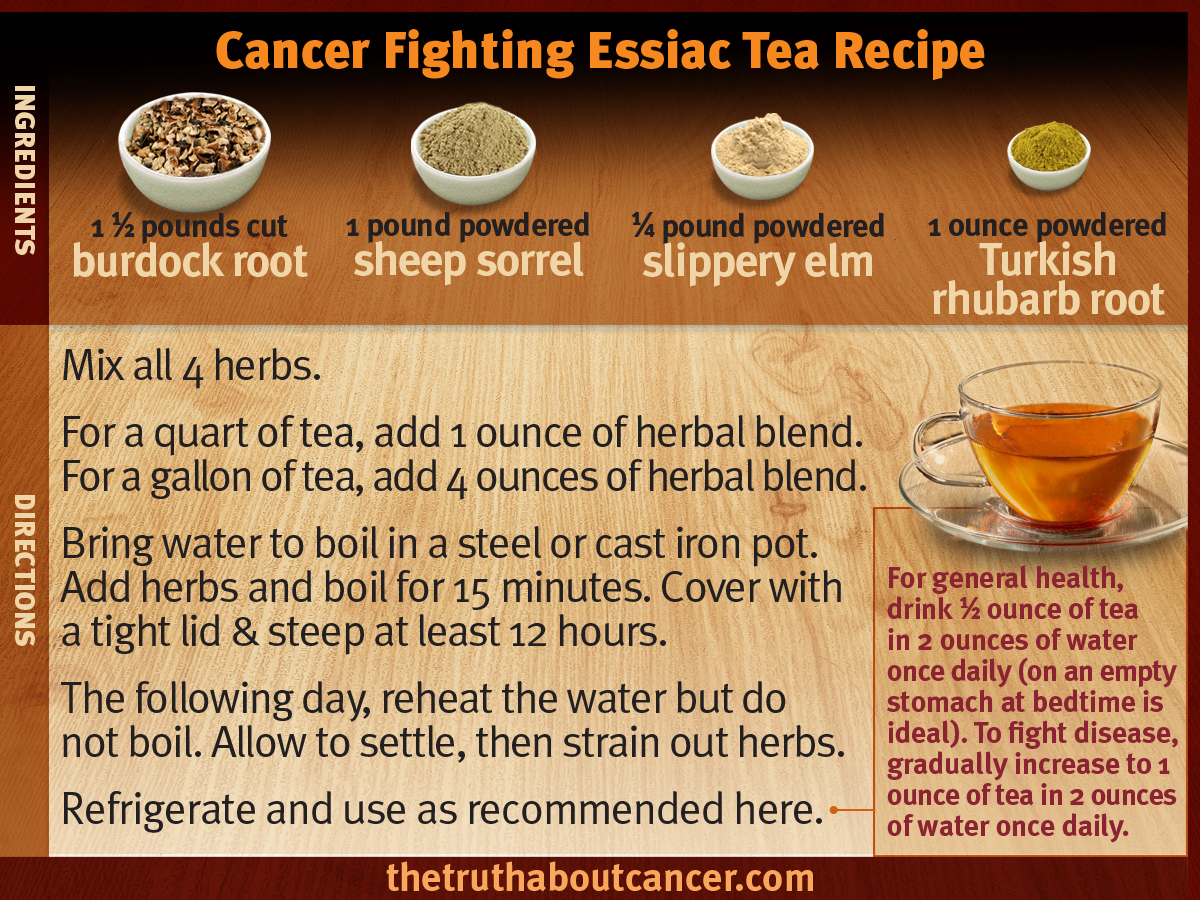
Ingredients in Essiac Tea Recipe:

  • 1 ½ pounds cut burdock root (Arctium lappa is a natural blood detoxifier)
  • 1 pound powdered sheep sorrel (Rumex acetosella is a powerful antioxidant)
  • ¼ pound powdered slippery elm (Ulmus fulva is a powerful antioxidant)
  • 1 ounce powdered Turkish (Indian) rhubarb root (Rheum pamatum is a phytochemical that is naturally astringent, anti-microbial, antifungal, and anti-inflammatory)

Directions to Make Essiac Tea

  1. Mix all four herbs thoroughly, store in a tightly sealed glass container away from light
  2. For a quart of tea, you need 1 ounce of herbal blend
  3. For a gallon of tea, you need 4 ounces of herbal blend
  4. Bring desired amount of water to a rolling boil in a steel or cast iron pot for 15 minutes
  5. Cover with a lid, steep at least 12 hours
  6. The following day, reheat the water but do not boil
  7. Allow to settle, then strain out herbs (there will be sediment in the bottom)
  8. Pour into tightly sealed glass or ceramic containers and cool
  9. Refrigerate and use as recommended (sweetened with honey or natural sugar to taste)
For general health, drink ½ ounce of tea in two ounces of water once daily. Rene Caisse suggested it be taken at bedtime on an empty stomach. To fight disease, gradually increase consumption of Essiac tea to 1 ounce of tea in 2 ounces of water once daily. The tea can be consumed cold or hot and more water can be added for a milder flavor. Nurse Caisse cautioned against drinking more in hopes of better or faster results and to increase water consumption.
There doesn’t have to be an either/or relationship between conventional and alternative practitioners. The first goal, the only goal, should be saving lives. Essiac tea is a natural, well-tolerated holistic treatment… and Nurse Caisse’s patients lived to tell others about it.

Editor’s note: This post was originally published in February 2016. It has been updated and republished in November 2019.


Is Dairy Bad for You? 6 Facts About Dairy for Your Health


Doctor Claims Packing Hot Soup In Plastic Bags May Cause Breast Cancer, So Bring Containers Instead

Content extracted from website: https://mustsharenews.com/plastic-bags-breast-cancer/?fbclid=IwAR29FVAOEuINGKg8ucplu1nYD-MAlut68dCb-JGLudWylDvyvGr_vDxHJCo

The practice of bagging hawker food and hot soup in plastic bags might be common, but recent findings reported on Oriental Daily suggests that this should be less common.
A director of Shin Kong Wu Ho-Su Memorial Hospital, surnamed Zheng, has studied findings released by the National Health Administration of Taiwan.
Those who suffer from breast cancer before they turn 40 years old in Taiwan account for about 6-9% of all cases — a figure that’s slightly higher than in Europe and North America at 5-6%.

Difference due to takeaway practices, doctor says

The difference, Dr Zheng says, can be attributed to diet. Specifically, the practice of dabao-ing hot food and soup.
Although Taiwanese people don’t normally dabao kopi in plastic bags, Singaporeans do. Some older hawkers still use plastic bags for hot food & soup in Singapore as well.

Heated plastic bags can transmit synthetic plastic, causing breast cancer

According to Oriental Daily, local universities in Taiwan have found that young breast cancer patients have a higher concentration of synthetic plastic, or plasticiser, in their urine than healthy adults.
Dr Zheng thus draws a link between the amount of plastic that Taiwanese people use to the higher occurrence of breast cancer in younger patients.
She also mentions that Chinese people tend to prefer fairer skin and thus get less Vitamin D – aka sunlight – than they should. 15 minutes in the sun a day is enough Vitamin D for the body, she says.
Lack of Vitamin D is stated as being a reason for early onset of cancer.
In Singapore, the number of young breast cancer patients – below the age of 44 – was 1,656 during 2010-2014, which is 17% of all cases.
The number has actually decreased since 2005-2009, so the link may be weaker in Singapore than in Taiwan.

Plastic bag link to breast cancer exists

Keeping in mind that Singaporean hawkers have largely switched to styrofoam or paper boxes for takeaways, the breast cancer issue might probably be country-specific.
However, the ideal situation is to avoid such plastics – both for health reasons and to reduce waste.
So that’s another reason to bring your own container to dabao food for lunch. Oh, and lunch is a great time to bask in the sunlight too.
Featured image adapted from NTU and Ben Alagnam.

Tea for fresh breath

Website: 1 尧妈汤厨发布了一篇小红书笔记,快来看吧! 😆 4zUicIOeSVfYiUW 😆 http://xhslink.com/uhQqLj,复制本条信息,打开【小红书】App查看精彩内容! Tea Ingredients: 竹蔗 Dried Sugar Can...