Saturday, November 16, 2019

Prebiotics and Probiotics: Why You Need Both for a Healthy Gut

Content extracted from website: https://thetruthaboutcancer.com/prebiotics-and-probiotics/?utm_source=SM-Facebook&utm_medium=fb&utm_term=prebiotics-and-probiotics&utm_content=FB-prebiotics-and-probiotics_11%252F12%252F2016&gl=582845529

Every year when spring finally breaks from the relentless chill of winter, my family and I eagerly plant our garden boxes with seeds that, at various intervals throughout the year, will blossom into luscious plants bearing all of our favorite fruits and vegetables.

It’s a cherished labor of love that we all know requires not just the seeds, of course, but plenty of healthy soil, sunlight, water, and fertilizer… a surefire recipe for growing some of the best, nutrient-rich produce this side of the Mississippi, if I do say so myself!

I wouldn’t call myself an expert gardener by any means, but I think I have a pretty solid understanding of what it takes to grow healthy food. And as I continue to learn more about what it takes to grow and maintain a healthy, cancer-free body, I recognize that the inputs for both are much the same.

The foods we eat are a lot like seeds, which need to be planted into healthy soils (our digestive systems) in order to grow and bear fruit. We also have gut microflora and various other intestinal elements that act as “water” and “sunlight” to support a bounteous “yield.” In this case the successful digestive conversion of the foods we eat into the substances our bodies need to generate muscle tissue, cellular matrices, energy, and the various other building blocks of life.

But what about the fertilizer? It’s something that’s rarely talked about when dealing with the issue of digestive health. Most of the focus centers around probiotics − the “soil” in our digestive tracts that works in tandem with enzymes, bile, hydrochloric acid, and other digestive “juices” to process the foods we eat.

As it turns out, probiotics require their own food or “fertilizer” in order to function properly, and many people aren’t getting enough of it to support a healthy microbiome. In other words, their “soils” are deficient or altogether dead, resulting in inadequate uptake and assimilation of nutrients.

Without Prebiotics, Probiotics Can’t Do Their Job


probiotic-rich foods

You’re probably already familiar with probiotics because they’ve gotten a lot of media attention in recent years for their role in improving digestive health. But their most important co-factor is rarely mentioned − and when it is, it’s often poorly defined. I’m talking about prebiotics, a class of plant fiber that’s non-digestible in humans, but that serves as the critical food source for the probiotic bacteria that occupy your colon and bowel.

Probiotics, as you may already know, are the living bacteria that colonize our intestinal tracts and perform a number of important functions related to digestion and immune protection. They’re a natural feature of the gut and body, and prebiotics are their food source. Probiotics consume and ferment this food source in order to increase mineral absorption, promote the production of short-chain fatty acids, protect the intestinal lining, balance hormones, and facilitate the proper elimination of waste.

Unlike probiotics, which are extremely sensitive to heat and stomach acid, prebiotics are virtually indestructible in the human body. As much as 90% of ingested prebiotic fiber is eliminated from the small intestine fully intact. This might sound like a bad thing, but it’s actually critically important because it’s the only way that the entirety of the probiotic ecosystem (which lives all throughout the roughly 28-feet of large and small intestines), is able to receive adequate nourishment.

In other words, our bodies need both prebiotics and probiotics in order for the gastrointestinal tract to function as it should. You can take all the probiotics in the world, but if you aren’t also taking prebiotics, you’re not going to see the results you hope to achieve.

Using the garden analogy I discussed earlier, simply throwing more seeds (probiotics) at the soil (the gut) won’t produce healthier plants unless they’re properly planted and fertilized (prebiotics)… an absolutely vital symbiotic relationship.

The Prebiotics You Need and Where to Find Them


There are two primary prebiotics that your body needs: inulin and oligofructose. There are also two sides to your colon, one side that prefers inulin (the left) and the other that prefers oligofructose (the right). These two prebiotics have been shown to provide maximum nourishment for your internal ecosystem. They help to multiply beneficial bacteria and combat gut dysbiosis, a bacterial imbalance in the gut that can result in indigestion, bloating, and other gastrointestinal symptoms.

Inulin is technically a long-chain prebiotic fiber that’s digested more slowly, while oligofructose is a short-chain prebiotic that’s digested more quickly. Any true, full-spectrum prebiotic supplement will contain both forms of prebiotic fiber, as well as fructooligosaccharides (FOS), galactooligosaccharides (GOS), and various other oligoosaccharides, all of which provide symbiotic nourishment in every area of your gut.
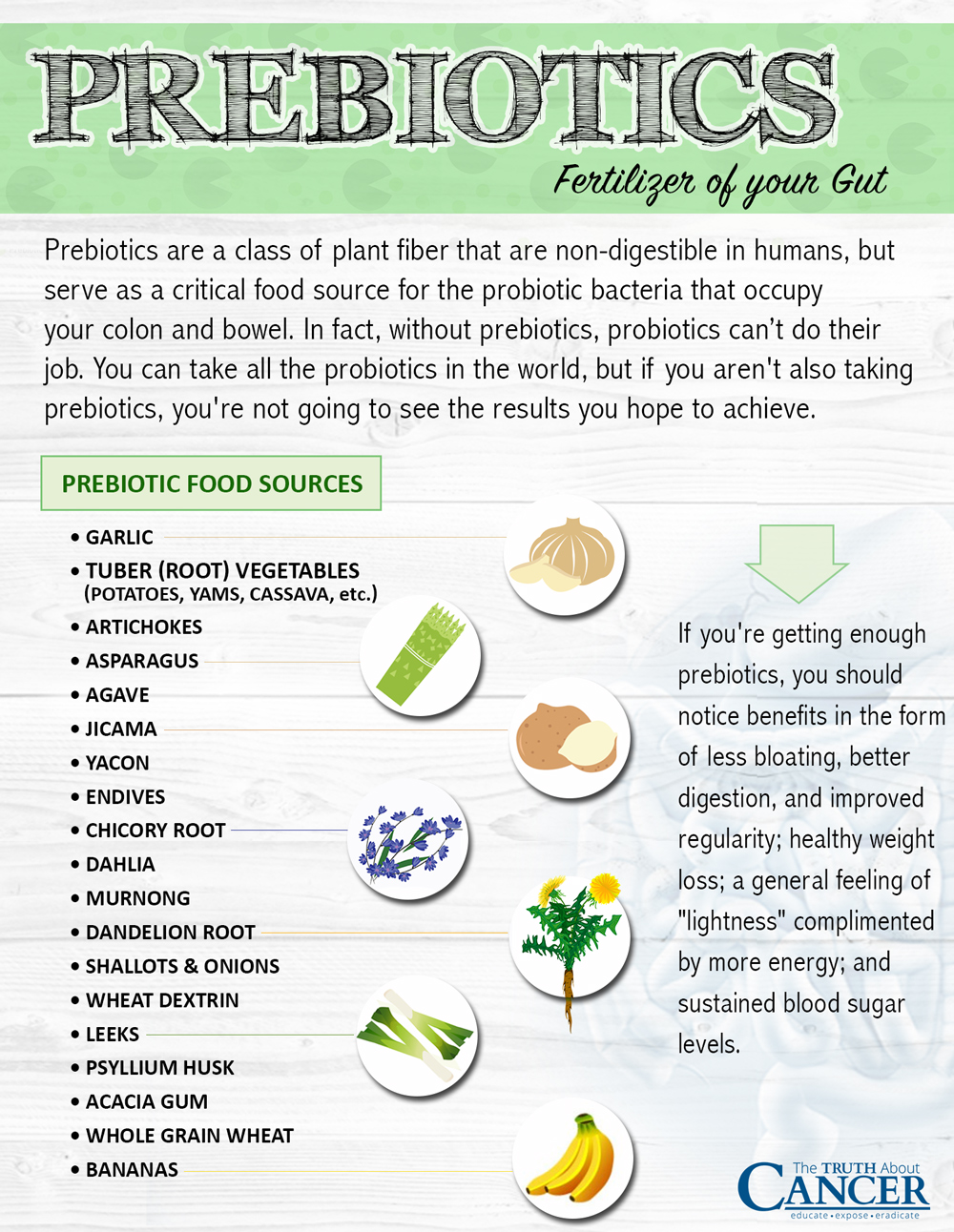
prebiotics-food-sources

It’s important to note here that prebiotics are a form of soluble fiber as opposed to insoluble fiber. Insoluble fiber is what most people refer to when they talk about “dietary fiber.” It’s basically an indigestible bulking substance that helps to “lubricate” the release of bound-up waste from the bowel.

Soluble fiber, on the other hand, is the prebiotic food that keeps probiotics nourished and happy − equally as important as insoluble fiber but in a different way.

Good Food Sources of Prebiotics


So which foods contain the highest levels of prebiotics? Most tuber (root) vegetables naturally high in inulin such as:

  • Potatoes
  • Yams
  • Sweet Potatoes
  • Cassava

as well as…

  • Artichokes
  • Asparagus
  • Chicory root
  • Bananas
  • Dandelion root
  • Garlic
  • Agave
  • Jicama
  • Leeks
  • Yacon
  • Endives
  • Dahlia
  • Murnong
  • Shallots
  • Onions

Wheat dextrin, psyllium husk, acacia gum, and whole grain wheat (just make sure it’s organic and glyphosate-free, if possible), are likewise rich in prebiotic fiber. And since many of these same foods also contain oligofructose, it’s easy to obtain both prebiotic forms simply by incorporating more of these foods into your regular diet.

If you’re getting enough prebiotics, you should notice benefits in the form of less bloating, better digestion, and improved regularity; healthy weight loss; a general feeling of “lightness” complimented by more energy; and sustained blood sugar levels.

By properly nourishing your gut microbiota you are likely to experience fewer infections, enhanced immune function, and better nutrient absorption… helping you to feel better all-around. You can also get sustained relief from conditions like leaky gut syndrome and irritable bowel syndrome, both of which can result from gut dysbiosis stemming from inadequate prebiotic intake.

Incorporating more prebiotic-rich foods into your diet is a no-brainer, and anyone with gut issues should absolutely do so as part of a diet-based corrective protocol to help improve digestion and immune function.

Editor’s Note: This post was originally published in September 2016. It has been updated and republished in March 2019.

Article Summary


  • Probiotics are the living bacteria that colonize our intestinal tracts and perform important functions related to digestion and immune protection.
  • Probiotics consume and ferment prebiotics in order to:
    • Increase mineral absorption
    • Promote the production of short-chain fatty acids
    • Protect the intestinal lining
    • Balance hormones
    • Facilitate the proper elimination of waste
  • Our bodies need both prebiotics and probiotics in order for the gastrointestinal tract to function as it should.
  • There are two primary prebiotics that your body needs: inulin and oligofructose.
  • Good sources of prebiotics include:
    • Potatoes
    • Yams
    • Sweet Potatoes
    • Cassava

Friday, January 25, 2019

Eye massage


The Benefits of Eye Massage with Dr Grace Tan


Eye Massage and Lymph Drainage Tutorial


Acupressure Self-care for Healthy Eyes and Sinuses

Irritable Bowel Syndrome (IBS) – Diet Plan And Treatment

Diet Plan
When I came across this IBS diet plan, it seemed quite comprehensive but I have not tried it out yet.
Irritable Bowel Syndrome (IBS) – Diet Plan And Treatment


Problems caused by too much fiber, how to reverse laxative dependency


Previously I was relying too much on a fiber powder, and if you take fiber, you have to drink a lot of water or it will get stuck. Now I am trying to reduce the intake of the fiber powder into half.


I didn't realize taking too much fiber can also cause so much problems.

How to Reverse Laxative Dependency


Content extracted from Website: https://healthfully.com/222896-will-laxatives-help-me-lose-weight.html


Laxative dependency is the result of overusing laxatives and stool softeners to the point where one cannot have a bowel movement without such medicinal aides. It can come about when people try to self-medicate their chronic constipation, or when people abuse laxatives for weight loss.


If you or someone you know suffers from laxative dependency, here are some steps you can take to help reverse this condition.


Laxative dependency is the result of overusing laxatives and stool softeners to the point where one cannot have a bowel movement without such medicinal aides. It can come about when people try to self-medicate their chronic constipation, or when people abuse laxatives for weight loss. 
If you or someone you know suffers from laxative dependency, here are some steps you can take to help reverse this condition.
Make a list of all the laxatives you take, and how often you take them. You may be surprised at how many pills and how much liquid medicine you consume in a month!
Next, begin to ween yourself off of laxatives by eliminating the harshest medications from your list. Don't go cold turkey on all of your bowel aides; keep taking the gentle medications. Also eliminate any harsh colon cleansing treatments.
After your body has adjusted to getting by with only gentle stool softeners and constipation relievers, cut your daily dosage in half. This may take some getting used to, especially if you rely on laxatives daily. As long as you can have a bowel movement twice a week, you will be okay.
When your body has adjusted to the new dosing, cut your daily dose in half again. Keep repeating the process until you need to take a laxative no more than once every two weeks. This process can take several months, but your colon will be healthier in the end.
In addition to gradually cutting back on your laxative dependency, you should drink more water, eat more fiber, and get more exercise. These three actions are the most important and effective things you can do to get your sluggish colon working back to normal.
As with recovery from other addictions, reversing laxative abuse can be a frustrating, and seemingly uphill battle. There are support groups in your area to help people getting over substance abuse. Check local listings, or ask your doctor for more information.

7 Problems Caused By Too Much Fiber

Content extraacted from Website: https://www.nutritionadvance.com/too-much-fiber/


It’s easy to spot media stories telling us to eat more fiber for a healthier life and better gut health.
We can see them pretty much every day, whether online, on TV or in the newspapers.
Also, there are dozens of studies vouching for the digestive health benefits of dietary fiber.
However, consuming any food compound in excess can be problematic, and fiber is no exception.
In fact, research shows that there are some side effects that consuming too much fiber can cause.
This article examines this issue in more detail.

Can You Have Too Much Fiber?

Just because fiber has benefits doesn’t mean we should eat as much of it as we can.
For one thing, it is possible to experience adverse effects if we consume too much, especially when supplementing.
Some possible symptoms of excessive fiber intake include stomach and digestive issues such as bloating, cramps, and gas.

But how much fiber is too much?

The “official” recommended daily fiber intake is set at around 30 grams depending on gender (1).
Anyone eating a standard whole-foods-based diet is unlikely to exceed this amount greatly.
However, those who go overboard on green smoothies, fiber supplements, and excessive amounts of grains might far exceed this figure.
More isn’t always better, and research shows that an excessive amount of fiber can cause problems.

Potential Problems Caused by Too Much Fiber

Here are a few signs, symptoms and problems that excessive fiber intake can cause.

1. Constipation

Picture of a man with stomach pain caused by constipation.
Usually thought of as a consequence of too little fiber, constipation may also result from an excessive intake. In fact, it can even be worse than on a low-fiber diet (2).
One study investigated fiber intake in 63 constipation patients who were currently on a high-fiber diet. The researchers split the participants into three groups; a no fiber, reduced fiber, and continuous high fiber diet plan.
Surprisingly, only the participants reducing their fiber intake saw a benefit. Participants who reduced their fiber intake had improvements in straining, gas, constipation, and anal bleeding (3).
The researchers explained that an over-consumption of fiber may cause constipation through a build-up of undigested matter in the digestive tract.
The risk is higher when first increasing fiber in the diet, so it’s important to increase fiber slowly if you plan on making any significant dietary change.
Lastly, a greater fiber intake increases the body’s water requirements, not drinking enough can cause dehydration and make the problem worse (4, 5).
Key Point: Evidence suggests that too much fiber can cause constipation. Studies also show that cutting down on fiber intake can be an effective remedy to relieve constipation.

2. Nutrient Malabsorption

In reality, most people already consume relatively low fiber diets. As a result, it’s rare to impede the absorption of nutrients through excessive fiber intake.
However, insoluble fiber—mainly found in whole grains—can reduce our absorption of certain nutrients.
Specifically, fiber can bind essential minerals including calcium, iron, magnesium, and zinc (6, 7).
For example, a recent randomized trial showed that a high intake of fiber causes a “slight but significant” reduction in calcium absorption (8).
Whole grain sources of fiber are also sources of antinutrients like phytic acid. While phytate can have some beneficial effects on our body, it’s also capable of binding minerals.
In particular, studies show that higher dietary phytate intake inhibits the absorption of iron, calcium, and zinc (9, 10).
Key Point: Dietary fiber decreases the bioavailability of some essential minerals. However, this effect is only slight for people with a reasonable fiber intake and would likely require excessive amounts of fiber to do harm.

3. Gas and Bloating

Girl Suffering From Gas and Bloating Holding Her Stomach.Gas and feeling bloated are two of the most common complaints against a high fiber diet plan.
Since we think it’s the healthy thing to do, many people go overboard and include too much fiber-rich food in each meal.
As the microbiota in our gut digest fiber, the process produces various gases. This gas can lead to belching, flatulence and abdominal bloating, causing a considerable amount of discomfort to sufferers (11, 12, 13).
If this is something that sounds familiar, then consider how much fiber you’re consuming.
This digestive distress is especially common when increasing fiber intake suddenly (14).
Foods such as beans and cruciferous vegetables like cabbage, kale, and sprouts are common culprits for gas production.
Key Point: Eating a few vegetables with a meal is perfectly healthy, but massive amounts is overkill. Too much fiber often causes gassiness and abdominal bloating.

4. Abdominal Cramping

Stomach cramps can be both painful and frustrating, and they can sometimes be a sign of excessive fiber intake.
The gases released by the breakdown of large amounts of fiber are the culprit, and studies show that reducing fiber intake can ease abdominal pain (15, 16).
In this case, it is a build-up of gases in the colon that causes the problem by exerting pressure on the colon walls.
A systematic review of randomized controlled trials demonstrates that fiber intake can relieve symptoms of irritable bowel syndrome – except for abdominal pain. This study found that “in some cases, insoluble fibers may worsen the outcome” (17).
While stomach cramping may be a sign of too much fiber, if it persists then seeing a doctor for an accurate diagnosis is important.
Key Point: Various studies show that too much fiber can lead to abdominal pain.

5. Intestinal Blockage

Fortunately, this condition is very rare and unlikely.
However, there are documented cases of gastrointestinal tract blockages, which are a serious medical emergency (18, 19).
Notably, too much fiber can increase the risk of a phytobezoar developing. This condition is a large, trapped mass in the digestive system which consists of fruit and vegetable fibers.
Coupled with inadequate chewing, a large intake of high-fiber food is one of the biggest risk factors for a phytobezoar (20).
A low-fiber diet is usually the default recommendation for those at risk of an intestinal blockage (21, 22).
Key Point: An intestinal blockage is pretty much the very worst case scenario, but a serious overload of fiber can lead to a bowel obstruction.

6. Dehydration

Dehydration as a result of excessive fiber depends on how much fluid the individual is consuming in the first place.
If it is an inadequate amount and fiber consumption increases, then it’s a possible cause of dehydration.
For larger amounts of dietary fiber, it’s important to ensure sufficient water intake.
The reason why is because soluble fiber absorbs water in the digestive tract, which increases the body’s hydration needs (23, 24).
You may have heard the “eight glasses per day” suggestion for water intake, but there isn’t much evidence behind this.
It’s incredibly difficult to ascertain how much water each individual needs, as this depends on so many different things. For example; the climate, physical activity, diet, and each person’s unique biology can all influence hydration levels.
With this in mind, judging water requirements by listening to thirst and urine color (ideally pale yellow) is ideal.
Key Point: An insufficient amount of water on a high-fiber diet will lead to dehydration.

7. Acid Reflux and GERD

Recently, evidence suggests that small intestinal bacterial overgrowth (SIBO) may cause some cases of acid reflux.
Acid reflux is otherwise known as gastroesophageal reflux disease (GERD), but you may know this best as heartburn.
Heartburn is a digestive disorder in which stomach acid leaks into the esophagus, and it may cause anything from mild discomfort to sharp, burning pain.
In cases of heartburn, gas from the bacterial fermentation of carbohydrates can rise upward.  As a result, these gases put pressure on the LES valve (lower esophageal sphincter) which keeps acid in the stomach and out of the esophagus.
For this reason, lowering carbohydrate levels has been put forward as a potential therapeutic solution to GERD.
There appears to be strong evidence too.
For instance, a recent 16-week study of 144 obese women with GERD saw all symptoms resolve in all women on a low-carb, high-fat diet (25).
Key Point: Higher amounts of fermentable carbohydrate such as fiber may play a role in symptoms of GERD.

How to Counteract Too Much Fiber

What can you do if you overeat fiber?
If you have symptoms of consuming too much, then the most important ways to counteract them are;
  • STOP fiber intake until the condition subsides: consuming more fiber when there is a large amount still undigested will worsen the problem.
  • Drink lots of water – adequate hydration will help with the digestion process.
  • Do some light exercise such as walking: exercise and movement are known to help improve constipation and speed digestion up.

Final Thoughts

Like with many things in nutrition, there isn’t always a clear black and white.
Despite all the health claims we read about fiber, it’s important to be aware of the possibility of adverse effects at higher levels of consumption.
It’s also worth remembering that some fiber-containing foods are incredibly nutritious – avocados, raspberries, and cacao just to name a few.

Tea for fresh breath

Website: 1 尧妈汤厨发布了一篇小红书笔记,快来看吧! 😆 4zUicIOeSVfYiUW 😆 http://xhslink.com/uhQqLj,复制本条信息,打开【小红书】App查看精彩内容! Tea Ingredients: 竹蔗 Dried Sugar Can...